DOM'S SNIPPETS
MORAL CONFLICTS DON’T GO AWAY

By Dominique Paul Noth
Like most toddlers I cared nothing about politics as long as I had food to eat, a place to sleep, toys to play with and no explosions in the dark.
Even in high school I remained naïve about struggles shaking the globe. But given my family history and when I was born (1942) I was forced to pay some attention to world events by age 5.
My earliest memories shortly after the war are gatherings of strangers (to me) at my apartment on East 89th St. in Manhattan, Surrounded by books in many languages, alcohol and music, old family acquaintances kept pouring in – some missing limbs, many looking haggard – reunited in lavish embraces and screams over seeing children at play. Many tried to pinch my cheek as I remained bewildered about just who they were and from where they had descended up on us.
I quickly learned. They were refugees finding their way from Europe to a future in America.
I was born during World War II, knowing vaguely that my father was serving at the Pentagon (not unusual back then but apparently startling today -- immigrants who were experts in languages and noted anti-Nazis were quickly recruited by the military).
The times and the circumstances interfered with these childhood years unlike anything my family today experiences in the US. You have to understand. Both my parents were noted escapees from Nazi Germany – he a writer whose books had been burned, she an emerging opera singer who happened to be Jewish.
One day in 1933 she sensed she was being followed from opera house to opera house, so she got on a train to Munich from Berlin and just kept going into France, where her husband-to-be had fled months earlier. They had established distinguish careers – until the Nazis invaded and sent my mother and two older brothers into an internment camp while my father was hidden out by the Dominicans.
The story of their escape to the US in 1941 is one of the most fascinating chapters (to me at any rate) in the memoirs of Dominican priest Raymond Bruckberger, later the chaplain to General de Gaulle. Bruckberger waited for good reason until 1978 to write “You Will End Up on the Scaffold” (title translated from the French).
With that heritage I was quietly aware of events around me. The big one I remember, it must have been in 1947, was when the United Nations declared Israel a state and President Truman quickly agreed.
I sure remember the explosive satisfaction in my household. It remained a triumph of justice for me that lingered for decades – reinforced by movies like “Gentleman’s Agreement” (1948, but I must have seen it a decade later on television) and “Exodus,” recalling the political and the military survival of the Jewish people as a cause for celebration.
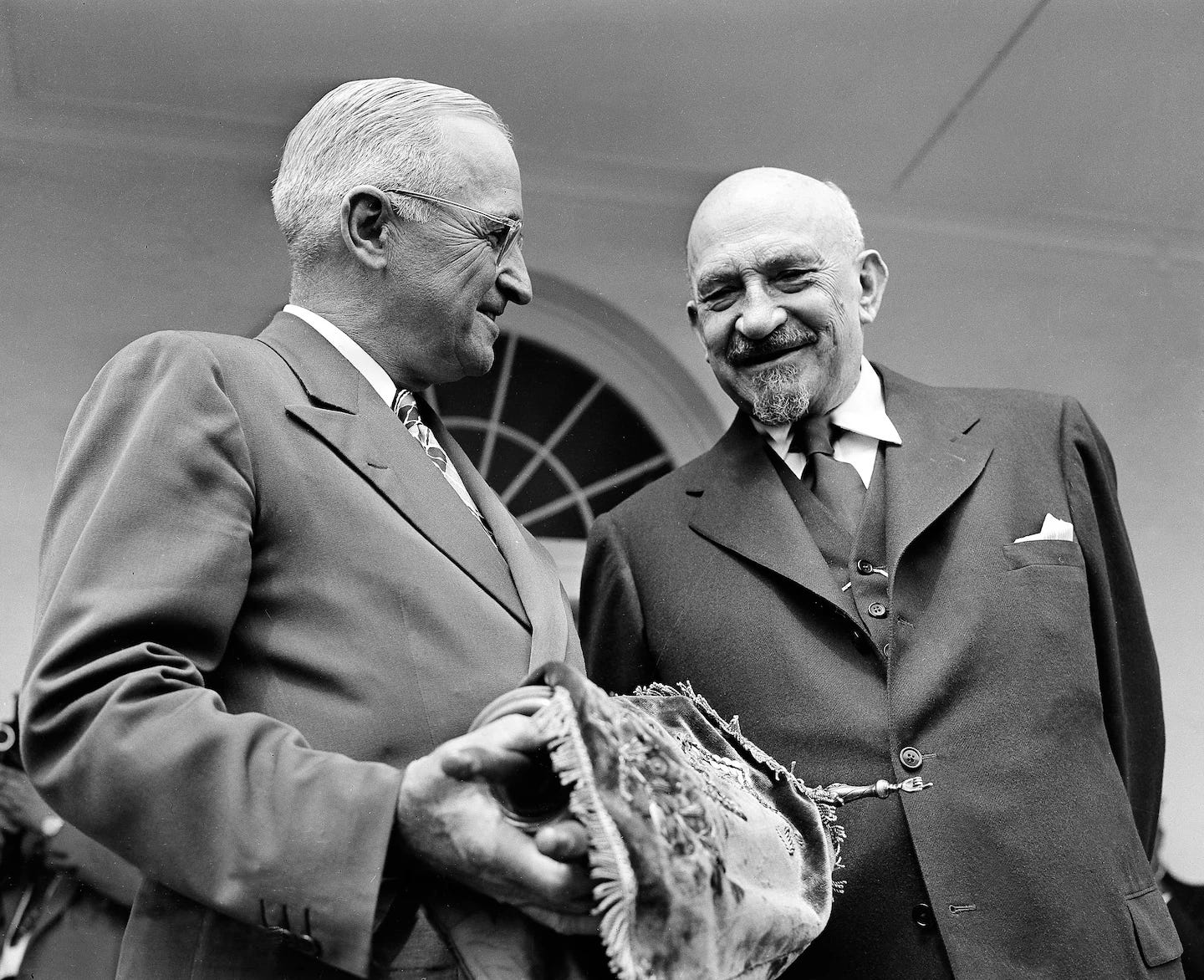
PresidentTruman, left, holds a copy of the Torah presented to him by Israeli leader Chaim Weizmann in May 1948.
As far as I remember, all American felt like that. The Arab nations were our idea of evil trying to destroy the Jews. Didn’t they understand the suffering the Jewish people had gone through? Hadn’t they seen the filmic visions of the death camps?
I was even aware in my childhood that there had been a fevered philosophical resistance among the Jewish people about entering politics and militant national leadership back in the 1940s. Chaim Potok’s famous novel “The Chosen” (not to be confused with the current biblical TV series of the same name) didn’t come out until 1967, later became several movies, a play and even a musical. It revived the debate back in the 1940s between Jews who clung to purity of staying out of politics and those who were eager for the Jewish people to rule their own land after centuries as despised wanderers.
I had heard mumblings of the controversy back in the 1940s but just fragments of loud voices discussing it. Since my parents were both linguists, their conversations could switch easily back and forth (French, German, Spanish, Italian). I was attending a school where the lessons were both in French and English (L’ecole Francaise) so I actually spoke French in my infancy, but when my parents moved the talk into German, I gave up. I knew they had other languages to go to.
I remained sturdily in the pro-Israel camp for decades, especially when I heard persistent streaks of casual anti-Semitism in the region I was transferred to.
It’s a whole other story I may share someday of how at age 6 I was kidnapped to Oklahoma (a family dispute between my mother and father that was settled within a few years, I later learned). But consider the mixed feelings of a child with my New York attitudes and freedom to roam the concrete streets confronted with the small town and redneck attitudes that exist even in a college town like Norman.
It probably made me cautious in conversation, or I was just too busy and happy blowing up ant colonies or playing with shortwave radio to get WMAQ’S clear-channel late night jazz show with Dave Garroway. Only in late high school did I let loose my political feelings about the state’s racism and bigotry – and my defense of Israel, which was going through several wars against its large and rich Arab neighbors.
It won on the battlefields, and its political attitude and justifications toward the Arabs harden. In the Carter and Bill Clinton years there were peace efforts, but what I most remember is that it was a Jewish right-winger who assassinated Israel premier Itzhak Rabin in 1995, for seeking accords with the Arabs. That brought back to mind the 1940s debate within the Jewish community.
It was in much later decades that I found my attitude going through changes – the Benjamin Netanyahu years. Congress was certainly going along with military aid that Israel was using to take apart Gaza. American politicians tsk-tsked but Bibi got more hard-headed. Then along came Trump, and historians had to deal with a remarkable reversal – Germany, despite its lingering authoritarian side, was being harder on the Palestinian conflict than the US. Trump kept saying that anti-Semitism was still rampant at universities, but I had taught at universities and what I noticed after Sept. 11 was a violent increase in anti-Muslim hatred. I suspect we are now entering a stage where anti-Bibi hatred is what’s growing.
It remains a most confusing issue in a confusing world. I have friends I admire in politics – lawyers, legislators – but nothing has ripped apart their emails to me as this. One side taking Israel’s side in all things, the other pleading for Gaza freedom and humanitarian relief.
This is the conundrum the American voters are facing. I may be ready for a sea change. But look how long it took.
This was very interesting to read. You are so right. It is confusing. When someone with your history is confused, my 80 year old Irish self feels..it’s not just me. Those with deeper roots also feel the tectonic plates moving. I listen to the Ezra Klein Show for help in understanding my world, this world.